Updated April 2026 · By the Guided Planners Team · 10 min read
You know that Sunday-evening feeling when the week hasn’t even started, but somehow you already feel behind?
There’s the dentist appointment you forgot to write down, a bill that’s probably due in a few days, and no clue what dinner is on Wednesday. On top of that, the house needs attention, the calendar is full, and your brain is trying to hold everything at once.
That’s exactly where a good home planner organizer helps.
Not because you need to “get more disciplined.” Most people aren’t failing because they’re lazy. They’re overwhelmed. A solid planner gives every appointment, task, budget item, meal idea, and household responsibility a proper place — so your mind can stop trying to carry it all.
We spent six weeks testing some of the most popular home organizer planners of 2026, from premium paper planners to free digital tools, to figure out which ones actually work in real life. Not in theory. Not on Pinterest. In actual homes with actual schedules, bills, groceries, and chaos.
Here’s what stood out.
In a hurry? Jump straight to our free printable home planner — no email required, instant download.
What Is a Home Planner Organizer?
A home planner organizer is a central system — paper, digital, or a mix of both — that helps you manage your household in one place.
That can include:
- schedules and appointments
- monthly bills and budgets
- meal planning and grocery lists
- home maintenance tasks
- important contacts and household information
- projects like renovations, moving, or seasonal organizing
The best systems don’t replace every other tool you use. They simply become the hub that keeps your household running.
And if you’re juggling bigger life transitions too, it helps to use planners built for those specific seasons. For example, if you’re preparing for a move, adding a dedicated moving planner checklist can keep timelines, packing, and address changes from turning into last-minute chaos. If you’ve recently bought your first home, a specialized first-time homeowner planner can help you stay on top of maintenance, finances, renovations, and all the little responsibilities nobody warns you about.
The 8 Best Home Planner Organizers of 2026
Quick Comparison Table
| Planner | Best for | Format | Price | Our Score |
|---|---|---|---|---|
| Guided Planners Home Organizer | Guided structure + prompts | Physical + PDF | Free / Premium | 9.4/10 |
| Cozi Family Organizer | Busy families, shared calendars | App | Free / $39/yr | 9.1/10 |
| Home Binder System (DIY) | Total customization | Physical binder | $10–25 | 8.9/10 |
| Notion Home Dashboard | Tech-comfortable households | Digital | Free | 8.7/10 |
| Erin Condren Home Planner | Beautiful physical planner | Physical | $55–75 | 8.5/10 |
| Google Workspace Suite | Simple, free, cross-device | Digital | Free | 8.3/10 |
| Amazon Home Organizer Planner Books | Budget physical planner | Physical | $12–22 | 7.9/10 |
| Happy Planner Home Edition | Creative/visual planners | Physical + PDF | $30–45 | 7.7/10 |
1. Guided Planners Home Organizer — Best Overall
Best for: Anyone who wants structure without building a system from scratch
Format: Physical book + free PDF printable
Price: Free printable · Premium from $24.99
After testing dozens of systems, this one stood out for one simple reason: it removes decision fatigue.
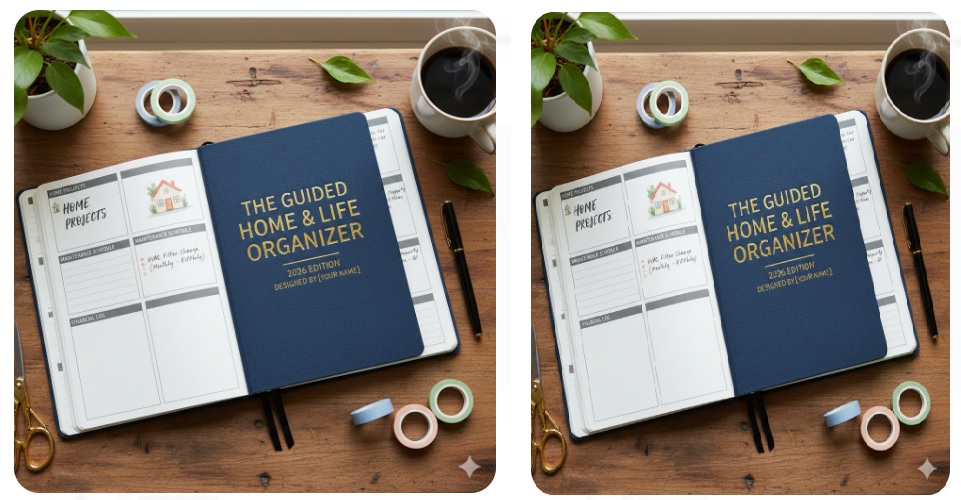
A lot of home planners hand you a bunch of blank pages and call it “flexible.” But blank pages can be surprisingly stressful when you’re already busy. The Guided Planners Home Organizer gives you clear sections and prompts, so instead of wondering what belongs under “finances” or “home management,” you can actually start filling things in.
What we tested it on:
- A household of four managing two kids’ activity schedules
- A single-person apartment tracking freelance income and bills
- A couple balancing day-to-day life with a home renovation
It held up well in all three.
The meal planning section was one of the strongest we tested because it connects weekly meals directly to a grocery list. That sounds obvious, but very few planners make it feel seamless.
Standout features:
- Monthly overview for bills, appointments, and top priorities
- Home maintenance tracker for quarterly and annual tasks
- Emergency contacts and household info section that’s actually useful
- Free PDF version available immediately with no subscription
One of the biggest strengths is that it works especially well alongside more specialized home planning tools. For example, if you’re remodeling, pairing it with a budgeting and expense tracking planner for home projects makes it much easier to separate daily household planning from renovation spending, contractor costs, and project decisions.
The honest downside: The physical version is US Letter size, which may feel a little large if you prefer something more portable. If that’s an issue, the PDF version is the easier choice because you can print it in a smaller format.
Our score: 9.4/10
Download the free home planner printable → Guided Planners
2. Cozi Family Organizer — Best for Households with Multiple People
Best for: Families who need everyone on the same page
Format: App (iOS, Android, browser)
Price: Free · Cozi Gold $39.99/year
Cozi solves a problem that paper planners can’t fully solve: getting multiple people to use the same system consistently.
Each person gets a color on the shared calendar. Grocery lists update live. Chores can be assigned with reminders. If your partner adds milk in the morning, you’ll still see it when you stop at the store later.
That kind of real-time coordination is where Cozi shines.
What makes it genuinely useful:
- Shared family calendar with color-coded schedules
- Live-sync grocery lists
- Meal planning with recipe import
- Recipe box for saving repeat meals
Where it falls short:
Cozi is excellent for coordination, but it’s not a full household command center. It won’t walk you through annual home maintenance, long-term budgeting, or bigger household projects in a structured way.
If your life includes more than just schedules — like repairs, budgeting, moving prep, or renovation planning — it works best as a companion tool rather than your only system.
Our score: 9.1/10
3. Home Binder System (DIY) — Best for Full Customization
Best for: People who never quite fit into pre-made planners
Format: Physical 3-ring binder
Startup cost: $10–25 for binder, tabs, and printed pages
The DIY home binder takes more effort upfront, but for the right person, it’s incredibly satisfying.
You choose exactly what goes in it. No wasted sections. No layouts that don’t fit your life. Just the pages your household actually needs.
A smart section structure:
- Master calendar — monthly overview, one page per month
- Finances — bills, budget, annual subscriptions
- Meal planning — weekly meals + grocery list
- Home maintenance — seasonal checklists, warranties, service records
- Emergency info — insurance, utilities, contacts
- Projects — decluttering, renovations, upgrades
- Kids/Pets — only if relevant to your household
If you’re building a binder from scratch, this is also a smart place to link in planners for major life events. A moving planner checklist fits naturally into a projects or transition section, while a first-time homeowner planner can help fill in the maintenance, budgeting, and home setup pieces many generic binders miss.
Pro tip: Start with three sections, not ten. Most DIY systems fail because they become too complicated before they become useful.
Get free printable pages for each section → Guided Planners printables library
Our score: 8.9/10
4. Notion Home Dashboard — Best Free Digital Home Planner
Best for: Tech-comfortable households who want flexibility
Format: App / browser
Price: Free for personal use
Notion is one of the most flexible free home planning tools available in 2026.
The trade-off is setup time. It doesn’t come ready-made as a household planner, so you’ll need to build it or use a template. That usually takes a couple of hours, but once it’s set up, it can be incredibly powerful.
Great starter templates:
- The Ultimate Home Hub
- Family Dashboard
- Home Maintenance Tracker
What Notion does especially well:
- Everything is searchable
- You can link tasks, budgets, notes, and contacts together
- It syncs across devices
- Databases make filtering and sorting easy
What it doesn’t replace:
It doesn’t give you the same “always visible” feeling as a paper planner sitting open on the kitchen counter. And for many people, that visibility matters more than flexibility.
5. Erin Condren Home Planner — Best Premium Physical Planner
Best for: People who want a beautiful planner they’ll actually enjoy using
Format: Physical spiral planner
Price: $55–75
If aesthetics help you stay consistent, Erin Condren deserves a serious look.
It’s polished, customizable, and clearly designed for people who want planning to feel enjoyable rather than purely functional. The paper quality is excellent, the layouts are thoughtful, and it’s one of the few premium planners that feels like a product you’ll want to keep out on your desk.
Why people love it:
- Customizable covers
- Thick paper
- Clean layouts
- Separate sections for daily and home management planning
The trade-off:
It’s expensive, and because it’s dated, starting late in the year doesn’t feel ideal. If budget matters, it makes more sense to test your habits first with a printable system before upgrading.
Our score: 8.5/10
6. Google Workspace Suite — Best for Tech-Comfortable Minimalists
Best for: People already using Google tools
Format: Digital
Price: Free
If you already live inside Gmail and Google Calendar, this is the lowest-friction option.
A shared family calendar, a simple budget spreadsheet, and a grocery list in Google Keep can cover a surprising amount of your household planning needs without spending anything.
A setup that works:
- Google Calendar: shared household calendar + individual calendars
- Google Sheets: monthly budget, recurring bills, sinking funds
- Google Keep: grocery list, reminders, quick notes
Why it doesn’t score higher:
It works, but it’s not guided. You’re still piecing together your own system, and the tools don’t feel as unified as a planner built specifically for home organization.
If you’re someone who does better with prompts, templates, and ready-made sections, a guided system will probably save you time and mental energy.
Our score: 8.3/10
7. Amazon Home Organizer Planner Books — Best Budget Physical Option
Best for: People who want a physical planner without a premium price
Format: Physical book
Price: $12–22
Budget planner books on Amazon have improved a lot. You can now find solid options with cleaning schedules, budgeting pages, meal planning sections, and family calendar spreads for under $20.
What to look for:
- Undated pages
- A proper bill tracker
- Enough writing space
- Dedicated meal planning and household sections
Budget-friendly planners are often a good starting point if you’re still figuring out your style. But if your household includes more complex responsibilities like renovation budgeting or moving, those generic books usually don’t go far enough. That’s where niche tools like a home project budget and expense tracker or a dedicated moving planner checklist become much more practical.
Our score: 7.9/10
8. Happy Planner Home Edition — Best for Creative and Visual Planners
Best for: People who enjoy customizing their planner
Format: Physical disc-bound + PDF
Price: $30–45
Happy Planner is ideal for people who want planning to feel creative.
Its disc-bound format makes it more flexible than a traditional spiral planner because you can move pages around, add inserts, and personalize the layout more easily. For some people, that creative element is the very thing that keeps them engaged.
Best for:
- Visual thinkers
- Sticker lovers
- People who enjoy customizing layouts
- Anyone motivated by making their planner feel personal
Less ideal for:
If you want clean, minimal, no-fuss planning, this probably won’t be your favorite. It’s better for people who enjoy the process, not just the outcome.
Our score: 7.7/10
How to Choose the Right Home Planner Organizer for Your Household
Not every planner works for every home. The best choice depends less on features and more on how your household actually functions.
Choose a physical planner if:
- You spend regular time at a desk or kitchen table
- Writing by hand helps you remember things
- You want a screen-free system at home
Choose a digital system if:
- Multiple people need shared access
- You need your planner on your phone
- Real-time syncing matters
Choose a guided system if:
- You’ve tried organizing before and gave up
- Blank pages overwhelm you
- You want to start fast without building from scratch
Choose a DIY binder if:
- Most planners feel close, but not quite right
- You enjoy customizing systems
- You’re willing to invest a few hours upfront
And if you’re in a specific phase of home life, choosing a planner designed for that season makes a big difference. A first-time homeowner planner is especially helpful if you’re managing maintenance, finances, and unexpected responsibilities for the first time. If you’re preparing for a move, a moving planner checklist can prevent the usual last-minute scramble.
5 Home Organization Habits That Make Any Planner Work Better
Even the best home planner organizer won’t help much if it lives in a drawer.
The households that stay organized usually aren’t using a magical system. They’re just consistent with a few simple habits.
1. Do a 10-minute weekly reset
Pick the same time every week. Sunday evening and Monday morning both work well. Review the calendar, bills, groceries, and top priorities before the week gets away from you.
2. Capture things immediately
The moment a date, task, or reminder appears, put it in your system. The longer you wait, the more likely it disappears.
3. Check your maintenance tracker monthly
Small maintenance tasks prevent bigger, more expensive problems later. That applies whether you live in your first home or your fifth.
4. Review your budget, not just your spending plan
A written budget is only useful if you come back to it. This is especially true if you’re also managing repairs, decorating, or remodeling. A dedicated budgeting and expense tracker for home projects can make that review much easier when renovation costs start blending into normal household spending.
5. Don’t aim for a perfect planner
Aim for a used one. Messy and functional beats beautiful and abandoned every time.
Frequently Asked Questions
What is the best home planner organizer for 2026?
For most households, the Guided Planners Home Organizer offers the best balance of structure, ease of use, and affordability. Families who need live syncing may prefer Cozi, while digital-first households may lean toward Notion.
What should a home planner organizer include?
A useful home planner should include a master calendar, bill tracker, budget section, meal planner, grocery list, maintenance schedule, emergency information, and space for home projects. If you’re going through a life transition, it can also help to add a first-time homeowner planner or a moving planner checklist.
Is a digital or physical home planner organizer better?
Neither is universally better. Paper planners work well for people who like writing by hand and want something visible. Digital systems are better for families who need shared access and updates across devices.
How do I start using a home planner organizer if I’ve failed before?
Start with just two sections: your calendar and meal planning. Use them for 30 days before adding more. Most people fail because they try to organize everything at once.
Are free home planner organizer printables worth using?
Yes. Free printables are one of the best ways to test a system before spending money. They’re especially helpful if you want to build a custom binder or figure out which layouts actually fit your routine.
The Bottom Line
The best home planner organizer for 2026 isn’t the one with the most features.
It’s the one you’ll actually use when life gets busy.
If you’re starting from scratch, begin simple. Print the calendar page, the meal planner, and the bill tracker. Use those consistently for a month. Then add more only when you’re ready.
If your current system isn’t working, the issue is usually one of two things: it’s too complicated, or it’s too easy to ignore. A good planner should reduce mental load, not create more of it.
And if your household is navigating a bigger transition — buying your first home, planning a move, or managing renovation costs — adding the right supporting planner can make the entire system much more useful. Explore the first-time homeowner planner, the moving planner checklist, or the budgeting and expense tracking planner for home projects to build a setup that matches real life.
Download your free home planner organizer printable → guidedplanners.com — includes a calendar, budget tracker, meal planner, and home maintenance checklist. Instant PDF, no email required.