I know exactly what it feels like to stop feeling overwhelmed like a distant dream and start feeling overwhelmed like your permanent address.
You wake up already behind.
Your brain is running twelve tabs and none of them are loading.
You sit down to work and your body is buzzing like it just spotted a tiger, except the tiger is your inbox.
That’s not a mood.
That’s your fight or flight response firing off for a threat that doesn’t actually exist.
I’ve spent the last five plus years designing planners and productivity tools for women, men, professionals, educators, and nurses, and I can tell you the number one thing people message me about isn’t “I need prettier pages.”
It’s “I need my brain back.”
So let’s fix that.
What Feeling Overwhelmed Actually Means
Overwhelmed feelings aren’t a character flaw.
They’re a signal.
Your mind is telling you it’s holding more open loops than it can process at once.
Mental overwhelm shows up as racing thoughts, forgetfulness, and that fuzzy static where you can’t finish a sentence or a task.
Emotional overwhelm shows up as tears out of nowhere, snapping at people you love, or feeling numb when you should feel something.
Both are your nervous system waving a flag.
Ignore the flag long enough and you land in burnout, which is exhaustion plus cynicism plus the sense that nothing you do matters.
I’m not here to diagnose you.
I’m here to hand you a system, because a system beats willpower every single time.
Why You’re Feeling Overwhelmed by Everything Right Now
Here’s the uncomfortable truth.
You’re not overwhelmed because you’re weak.
You’re overwhelmed because your to do list is living in your head instead of on paper.
Every task you haven’t written down stays open in your brain like a browser tab draining your battery.
Stress and anxiety love that setup.
They feed on ambiguity.
“What am I forgetting” is scarier to your nervous system than any single hard task.
That’s why feeling stressed and overwhelmed almost always travels with feeling overwhelmed and exhausted, feeling overwhelmed and tired, and feeling overwhelmed and lost.
It’s not five separate problems.
It’s one problem wearing five costumes: too much unprocessed information and not enough structure to hold it.
Feeling Overwhelmed at Work
Work overwhelm has its own flavor.
Meetings stack on meetings.
Your task list refreshes faster than you can clear it.
You start answering messages the second you wake up because stopping feels dangerous.
If that’s you, I wrote a full workday reset system that walks you through resetting your day before it resets you. Check it out here.
Feeling Overwhelmed at Home and by Life
Then there’s the version that hits after hours.
Feeling overwhelmed with responsibilities at home, laundry piling up, kids needing rides, bills needing eyes on them, and somehow you’re also supposed to have a hobby.
If your whole life feels like it’s running you instead of the other way around, I built a guide for exactly that moment. Read how to get your life back under control here.
And if it’s less “one bad week” and more “my entire life needs a reset,” start here instead. This is your simple life reset.
15 Things You Can Do Today to Stop Feeling Overwhelmed
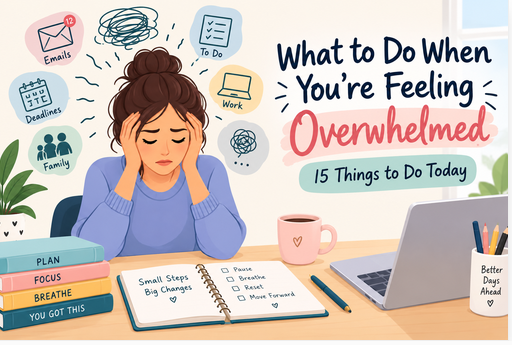
I put together a full breakdown of fifteen things to do today when the overwhelm hits, but here’s the fast version so you can start right now.
- Do a brain dump. Grab paper and write down every task, worry, and half formed idea in your head. Nothing is too small.
- Pick your one thing. Look at that dump and circle the single task that matters most today. One thing at a time beats ten things at once.
- Break it down. Big tasks feel heavy because they’re actually five tasks wearing a trench coat. Split them into smaller steps.
- Set a real boundary. Say no to one request today. Just one. Notice how the sky does not fall.
- Try box breathing. Inhale for four counts, hold for four, exhale for four, hold for four. Repeat five times. This calms your nervous system faster than most people expect.
- Use a grounding technique. Name five things you see, four you can touch, three you hear, two you smell, one you taste. It pulls you out of racing thoughts and back into your body.
- Move for ten minutes. Physical activity burns off the stress chemicals sitting in your system. A short walk counts.
- Protect your sleep tonight. Mental exhaustion and emotional exhaustion both get worse on poor sleep and better on decent sleep. This isn’t optional, it’s maintenance.
- Simplify your day. Cancel or delay whatever isn’t urgent. You’re allowed to move things.
- Talk to someone. Text a friend, call your sister, message your support system. Saying it out loud shrinks it.
- Batch your small tasks. Group errands, emails, and quick calls into one block instead of scattering them all day.
- Take an actual break. Not a doom scroll break. A real one, away from screens, even five minutes.
- Close the open tabs, literally. Digital clutter feeds mental clutter more than people realize.
- Write tomorrow’s top three tonight. Deciding before you’re overwhelmed again means less decision fatigue in the morning.
- Celebrate finishing something. Small wins retrain your brain to believe progress is possible, which is half the battle against burnout.
Want the full version with the “why” behind each one? Here are all 15 things to do today.

Building a Routine So Overwhelm Doesn’t Keep Coming Back
Quick fixes get you through today.
A routine keeps you from being back here next week.
Here’s what an actual daily routine that fights burnout looks like.
- A consistent wake time, even on weekends, because your body craves rhythm.
- A morning brain dump before you touch your phone.
- A prioritized to do list capped at three main tasks, not fifteen.
- A built in break every ninety minutes, not just when you collapse.
- A wind down routine at night that signals to your brain the day is actually over.
This is intentional living in practice.
Not some aesthetic, just a structure that protects your energy on purpose instead of by accident.
Self care isn’t a bubble bath.
It’s a system that stops you from running on empty in the first place.
When to Ask for Help
I want to be straight with you here.
Some overwhelm clears with breathing and a good to do list.
Some doesn’t, and that’s real too.
If your anxiety, mental exhaustion, or sense of burnout is sticking around for weeks, affecting your sleep, your relationships, or your ability to function, please talk to a doctor or a mental health professional.
Asking for help isn’t the failure.
Staying silent while you’re drowning is the actual risk.
A strong support system, whether that’s friends, family, or a professional, is one of the most protective things you can build for your mental wellness.
How a Planner Actually Fixes This
Here’s my honest take after five plus years of building these tools.
Your brain is not a filing cabinet.
It’s a processor.
The second you try to use it for both thinking and storing, everything slows down.
A planner takes over the storing job so your brain can focus on the thinking job.
That’s it.
That’s the whole mechanism behind why a good planner calms overwhelmed feelings faster than almost anything else you’ll try.
I built the Feeling Overwhelmed planner specifically for this exact moment, the one you’re probably in right now.
It’s got the brain dump pages, the priority sections, the boundary trackers, and the daily reset routines built right in, so you’re not reinventing this system from scratch every single day.
Grab the Feeling Overwhelmed planner here and give your brain somewhere to put all of this.
FAQs About Feeling Overwhelmed
What causes feeling overwhelmed by everything at once? Usually it’s too many unprocessed tasks and decisions living in your head with no system to hold them, combined with real stress, poor sleep, or ongoing anxiety stacking on top.
Is feeling overwhelmed the same as anxiety? Not exactly. Overwhelm is often a response to too much input right now. Anxiety can exist without a clear cause. They frequently show up together and feed each other, but they’re not identical.
How do I stop feeling overwhelmed and anxious fast? Start with box breathing or a grounding technique to calm your body, then do a brain dump to get the mental clutter out of your head and onto paper. Calming the body first makes the mental work much easier.
Can a planner really help with emotional overwhelm? Yes. A planner won’t fix everything causing your stress, but it removes the mental load of tracking and remembering, which is often the biggest driver of feeling overwhelmed and stuck.
When should I see a professional about burnout? If exhaustion, cynicism, or overwhelm have lasted more than a few weeks and are affecting your sleep, relationships, or daily function, that’s your sign to talk to a doctor or therapist.
You don’t have to keep living in that overwhelmed state.
You need a system, not more willpower, and that’s exactly what stops feeling overwhelmed from being your default setting.