You’re feeling overwhelmed at work and it’s only Tuesday.
Your inbox looks like a crime scene.
Your calendar is back to back with zero white space.
You’re answering Slack messages while eating lunch at your desk, if you’re eating lunch at all.
And somewhere in the back of your mind you’re wondering if this is just what having a job feels like now.
It’s not.
I’ve spent the last five plus years designing planners and productivity tools for professionals, nurses, educators, and anyone juggling a demanding career, and I’ve watched the same pattern over and over.
Smart, capable people convinced that burnout is the cost of doing business.
It’s not the cost.
It’s a symptom, and symptoms respond to systems.
Let’s build yours.
Why You’re Feeling Overwhelmed at Work in the First Place
Here’s the thing nobody tells you.
Feeling overwhelmed at work almost never comes from having too much to do.
It comes from having too much to track.
Every unfinished task, every “I’ll get to that later,” every message sitting unread is an open loop in your brain.
Your mind doesn’t know the difference between an urgent fire and a low priority email you forgot to answer.
It treats both like threats, which triggers the same fight or flight response you’d get from an actual emergency.
That’s why work stress feels physical.
Tight chest, shallow breathing, racing thoughts at your desk when nothing “bad” has technically happened yet.
You’re not imagining it.
Your nervous system is just responding to mental overwhelm the same way it would respond to danger.
The Difference Between Stress and Burnout
I want to be clear about this because people mix them up constantly.
Stress is a reaction to a specific pressure, like a deadline or a hard conversation with your boss.
Burnout is what happens when that stress never gets a chance to reset.
It builds, day after day, until you’re running on exhaustion, cynicism, and a creeping sense that nothing you do actually matters.
Emotional exhaustion and mental exhaustion are both signs you’ve crossed from “stressful week” into burnout territory.
If you’re feeling overwhelmed and exhausted, feeling overwhelmed and tired, or feeling overwhelmed and stuck at your desk more days than not, this isn’t a productivity problem anymore.
It’s a burnout problem, and burnout prevention starts with structure, not hustle.
What Feeling Overwhelmed at Work Actually Looks Like
Let me paint the picture, because I bet you recognize at least three of these.
- You open your laptop and immediately feel your shoulders tense up.
- You have a to do list so long you stopped looking at it.
- You say yes to another project because saying no feels impossible.
- You’re doing your actual job and also mentally rehearsing everything else you’re behind on.
- You leave work and can’t fully switch off, because your brain is still holding the whole list.
- Small interruptions, a Slack ping, an extra email, feel disproportionately irritating.
If that’s you, you’re dealing with a real, common version of feeling overwhelmed with tasks and feeling overwhelmed with responsibilities.
The good news is this responds fast to the right moves.
How to Stop Feeling Overwhelmed at Work Today
I’m not going to hand you a vague “just breathe” list.
Here’s what actually works, starting right now, at your desk.
- Do a brain dump before you open anything. Write down every task, email, and worry rattling around your head. Get it out of your brain and onto paper so your mind stops guarding it.
- Pick your one thing. Out of everything on that list, circle the single task that matters most today. One thing at a time beats a scattered ten.
- Break big projects into smaller steps. A project that says “finish report” is vague and heavy. A project that says “draft outline, then write section one” is doable in the next twenty minutes.
- Time block your calendar. Protect chunks of focused work the same way you’d protect a meeting. If it’s not blocked, it gets eaten.
- Use the two minute rule. If something takes less than two minutes, do it now instead of letting it join the pile.
- Batch your email and Slack checks. Checking constantly feels productive and actually fragments your focus. Pick two or three set times instead.
- Take an actual break. Not scrolling your phone at your desk. Step away, get outside if you can, let your nervous system come down from alert mode.
- Practice deep breathing between tasks. Even sixty seconds of slow breathing signals to your body that the threat has passed.
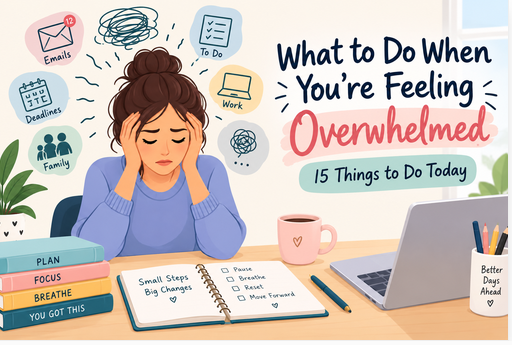
Want the fuller version of this with fifteen ready to use moves for any kind of overwhelm, not just work? Here are 15 things to do today when you’re feeling overwhelmed.
Setting Boundaries Without Feeling Like a Bad Employee
This is where most people get stuck, so let’s talk about it directly.
Setting boundaries at work is not the same as slacking off.
It’s the difference between a career you can sustain and one that burns you out in three years.
- Say no to meetings that don’t need you, and suggest an async update instead.
- Set an actual end time for your day and protect it like you’d protect a client deadline.
- Stop answering messages the second they arrive. Respond on your schedule, not everyone else’s.
- Tell your manager what’s realistic instead of quietly absorbing more.
I know that feels uncomfortable the first few times.
Here’s a quick story.
I worked with a nurse who told me she said yes to every extra shift because she didn’t want to let her team down.
Within a year she was so mentally exhausted she was making small mistakes she never used to make.
The turning point wasn’t a big dramatic conversation.
It was one boundary, one shift she declined, and the world kept spinning.
Prioritizing tasks and protecting your energy isn’t selfish.
It’s how you stay good at your job long term.
When Feeling Overwhelmed at Work Follows You Home
If work stress is bleeding into feeling overwhelmed at home too, you’re not dealing with two separate problems.
You’re dealing with one overloaded nervous system trying to run two full lives without a real reset in between.
I wrote a full guide for exactly that situation, walking through how to actually get your life back under control instead of just managing symptoms. Read it here.
And if your whole life, not just your job, feels like it needs a fresh start, start with this. Here’s a simple life reset.
Building a Routine That Keeps Work Stress From Piling Back Up
A good day gets you through today.
A routine keeps you from ending up right back here next month.
Here’s what a sustainable daily routine actually looks like for someone managing real work stress.
- Start your morning with a brain dump before checking email, so your priorities come from you, not your inbox.
- Cap your daily to do list at three main priorities.
- Block time for deep work and time for admin separately.
- Build in one real break, away from your screen, every few hours.
- Close your laptop at a set time and do something that has nothing to do with work.
This is what intentional living looks like in a career context.
Not some aesthetic idea, just a healthy routine that treats your energy like the finite resource it actually is.
If you want a simple, structured method to reset when work overwhelm hits hard, this walks you through it step by step. Here’s a simple 5 step method to stop feeling overwhelmed.
When to Ask for Help
I want to be honest with you here.
Some work overwhelm clears up with better boundaries and a solid to do list.
Some doesn’t, and that’s real too.
If anxiety, emotional stress, or burnout symptoms are sticking around for weeks and affecting your sleep, your relationships, or your ability to function at work, please talk to a doctor or a mental health professional.
Talking to someone, whether that’s a manager, a friend, or a professional, is a sign of strength, not a failure to cope.
A strong support system is one of the most protective things you can build for your mental wellness, at work and everywhere else.
How a Planner Fixes This Faster Than You’d Expect
Here’s my honest take after five plus years of building these tools for people just like you.
Your brain is not built to be a filing cabinet.
It’s built to think, solve problems, and make decisions.
The second you also make it store every task and deadline, it slows down on the actual thinking part.
A planner takes the storage job off your plate so your brain can get back to doing what it’s actually good at.
I built the Feeling Overwhelmed planner around this exact problem, with brain dump pages, priority sections, boundary trackers, and daily reset routines already built in, so you’re not rebuilding this system from scratch every Monday.
Grab the Feeling Overwhelmed planner here and give your workday somewhere to actually breathe.
FAQs About Feeling Overwhelmed at Work
Why do I feel overwhelmed at work even when I’m not that busy? Overwhelm often comes from mental clutter, not actual workload. Untracked tasks and unclear priorities create the same stress response as a packed schedule, even on a lighter day.
What’s the fastest way to calm down when work stress hits? Deep breathing or a quick grounding technique first, to calm your body, followed by a short brain dump to get the mental noise out of your head and onto paper.
Is feeling overwhelmed at work a sign of burnout? It can be an early sign. Occasional overwhelm is normal. Constant overwhelm paired with exhaustion and cynicism about your job points toward burnout.
How do I set boundaries at work without seeming difficult? Frame it around sustainability. Saying “I can take this on next week” or “let’s move this to async” protects your time while still showing you’re engaged and reliable.
Can a planner really help with work overwhelm? Yes. It won’t remove your workload, but it removes the mental load of tracking everything in your head, which is often the biggest driver of feeling overwhelmed at work in the first place.
You don’t have to keep white knuckling your way through every workday.
You need a system, not more hours, and that’s how you stop feeling overwhelmed at work for good.