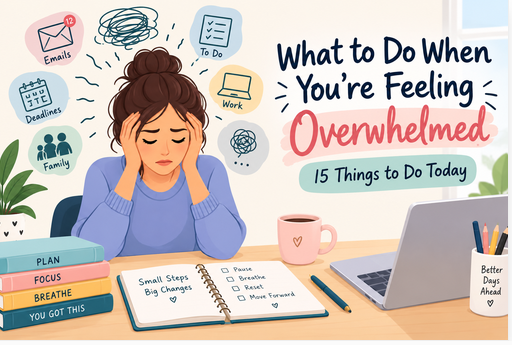
Feeling overwhelmed all the time is exhausting, and if you’re here, you already know that.
I’m going to show you exactly how to get your life back under control, starting today.
Feeling Overwhelmed All the Time? You’re Not Broken, You’re Buried
Let’s get one thing straight.
Feeling overwhelmed isn’t a personality flaw.
It’s a signal.
Your brain is telling you that the input has outpaced the output.
Too many tasks.
Too many decisions.
Too many people who need something from you.
Zero system to sort it out.
I’ve spent over five years building planners and journals for people drowning in exactly this.
Nurses.
Teachers.
Parents.
Founders.
The overwhelmed feelings show up the same way in almost everyone.
Racing thoughts at 2am.
A to do list that never gets shorter.
A body that’s tired but a mind that won’t shut off.
That’s not weakness.
That’s a system failure, and systems can be fixed.
What Emotional Overwhelm and Mental Overwhelm Actually Feel Like
People use “stressed” and “overwhelmed” like they’re the same thing.
They’re not.
Stress is a reaction to a specific problem.
Overwhelm is what happens when stress stacks up faster than you can process it.
Emotional overwhelm shows up as tears out of nowhere, snapping at people you love, or feeling numb when you should feel something.
Mental overwhelm looks like forgetting simple things, losing your train of thought mid sentence, or staring at your inbox for ten minutes without opening a single email.
Both are your nervous system waving a flag.
Both are fixable.
Neither means something is wrong with you as a person.
Feeling Overwhelmed by Life, Not Just One Bad Day
Here’s where it gets heavy.
Feeling overwhelmed by everything at once is different from a rough Tuesday.
It’s the sum of small pressures that never got resolved.
Let me break down where it usually comes from.
Feeling overwhelmed at work
Deadlines stack.
Meetings eat your calendar.
You’re expected to answer messages in real time while also producing real output.
Feeling overwhelmed at home
Dishes, laundry, kids, bills, a partner who needs you present, a house that never stays clean for more than an hour.
Feeling overwhelmed by everything
This is the combo plate.
Work bleeds into home, home bleeds into work, and you can’t find the line between the two anymore.
I’ve talked to hundreds of planner users who describe this exact pattern.
They’re not lazy.
They’re not disorganized people by nature.
They’re carrying a mental load with no container to put it in.
Feeling Overwhelmed and Anxious, Exhausted, or Stuck? Here’s the Chain Reaction
Overwhelm rarely travels alone.
It drags friends with it.
Feeling overwhelmed and anxious happens because your brain treats an unfinished task list like an unsolved threat.
Feeling overwhelmed and exhausted happens because your body burns real energy running background anxiety all day, even if you never leave your desk.
Feeling overwhelmed and tired stacks on top when sleep gets sacrificed to “catch up.”
Feeling overwhelmed and lost or feeling overwhelmed and stuck shows up when you don’t even know where to start anymore, so you start nowhere.
This chain reaction is exactly why quick fixes fail.
A bubble bath doesn’t fix a broken system.
A vacation doesn’t fix a broken system.
You come back and the pile is still there.
A Quick Story: The Nurse Who Couldn’t Remember Her Own Schedule
One of the planner users I worked with, a nurse working rotating shifts, told me something that stuck with me.
She said she stopped trusting her own brain.
Not because she was incapable, she’s one of the sharpest people I’ve talked to.
It’s because she was tracking patient notes, her kids’ school schedule, grocery lists, and her own shift rotation all in her head at once.
She’d walk into a room and forget why.
She’d double book herself constantly.
The moment she started dumping everything into one planner instead of her memory, the fog lifted within a week.
Not because her life got easier.
Because her brain finally had somewhere to put things down.
That’s the whole game.
The Real Cost: Burnout Isn’t a Buzzword
Burnout is a real, recognized state of chronic stress, and the World Health Organization classifies it as an occupational phenomenon.
It’s not “I’m a little tired.”
It’s a slow erosion of your energy, your motivation, and your ability to care about things you used to love.
Left unchecked, mental exhaustion and emotional exhaustion turn into full blown burnout.
That’s the stakes here.
This isn’t about looking productive on Instagram.
This is about protecting your health, your relationships, and your sanity.
How to Stop Feeling Overwhelmed: The Method That Actually Works
I’m not going to hand you fluff.
I’m going to hand you a process.
I break it down step by step in this simple 5 step method, but here’s the core of it.
Step 1: Do a Brain Dump
Get every single thing out of your head and onto paper.
Every task.
Every worry.
Every “I should probably…”
Your brain isn’t built for storage, it’s built for processing.
Once it’s on paper, your brain stops running the background loop trying to remember it all.
Step 2: Sort by What Actually Matters
Not everything on that dump list deserves your energy today.
Split it into three buckets.
Must happen today.
Should happen this week.
Can wait.
This single move kills most of the panic, because you finally see the real size of the problem instead of the imagined size.
Step 3: Break It Into Smaller Steps
“Clean the house” is not a task, it’s a category.
Break it down.
Wipe counters.
Start laundry.
Vacuum living room.
Small steps feel doable.
Doable steps get started.
Started tasks get finished.
Step 4: One Thing at a Time
Multitasking is a myth your brain sold you.
What actually happens is rapid switching, and every switch costs you focus and energy.
Pick one task.
Work it until it’s done or until the timer runs out.
Then move to the next.
Step 5: Set Real Boundaries
Setting boundaries means saying no to the extra project, the extra favor, the extra meeting that doesn’t need you in the room.
Protect your calendar like it’s your paycheck, because in a real sense, it is.
If this hits home, I wrote out 15 things you can do today to start clawing back control right now, not next month.
Grounding Techniques and Calming Your Mind in the Moment
Systems handle the big picture.
But sometimes you need relief in the next sixty seconds.
Here’s what actually works when overwhelming thoughts hit hard.
- Deep breathing: four seconds in, hold for four, out for six. Do it five times.
- Grounding techniques: name five things you see, four you can touch, three you hear, two you smell, one you taste.
- A short walk outside, even five minutes, resets your nervous system.
- Cold water on your wrists or face, it sounds basic, it works.
- Step away from the screen for two minutes and let your eyes rest.
These aren’t magic.
They’re circuit breakers.
They buy you enough calm to think clearly again.
Mindfulness, Meditation, and Building a Routine That Sticks
Mindfulness gets a bad reputation because people think it means sitting cross legged for an hour.
It doesn’t.
Mindfulness just means paying attention to the current moment instead of living three tasks ahead or two regrets behind.
Meditation is one tool for that, even five minutes a day trains your brain to slow the racing thoughts.
Pair that with a real daily routine, and the results compound.
Sleep on a consistent schedule.
Move your body, even a short walk counts as physical activity.
Eat on a schedule instead of grazing on stress snacks at your desk.
A self care routine isn’t selfish, it’s maintenance, the same way you’d maintain a car you drive every day.
Feeling Overwhelmed With Tasks and Responsibilities? Fix the Container, Not Just the List
Here’s the truth most productivity content skips.
You don’t have a motivation problem.
You have a container problem.
When your tasks, your goals, and your mental load live in fifteen different places, your brain has to hold the map on top of doing the actual work.
That’s why I built the planners I build.
One place for the brain dump.
One place for the daily priorities.
One place to track the habits that keep burnout away.
If work stress specifically is your trigger, I put together a simple workday reset system that takes minutes to set up and saves you hours of scattered energy.
Rest and Recovery Are Not Optional
I want to be blunt here.
You cannot outwork burnout.
Rest and recovery are part of the system, not a reward you earn after everything is done.
Sleep is when your brain actually files away the stress from the day.
Skip it consistently, and stress relief tools stop working as well because you’re fighting from a deficit.
Build recovery into your week the same way you build in deadlines.
Non negotiable.
Daily Stress vs. Life Stress: Know the Difference So You Fix the Right Thing
Not all overwhelm needs the same fix, and this is where a lot of people waste time.
Daily stress is the noise.
A tight deadline, a flat tire, a kid who won’t put on their shoes.
That stuff needs quick tools, like the grounding techniques above.
Life stress is the weight.
A job that’s not working, a relationship that needs a hard conversation, a health issue you’ve been ignoring.
That stuff needs real decisions, not a breathing exercise.
Here’s the mistake I see constantly.
People try to breathe their way through life stress and wonder why it doesn’t stick.
You can’t meditate your way out of a situation that actually needs to change.
Separate the two, and you’ll stop wasting energy on the wrong solution.
Prioritizing When Everything Feels Urgent
Here’s a hard truth.
When everything feels urgent, nothing actually is.
Your brain under stress treats every task like a five alarm fire, even the ones that can wait a week.
A simple filter fixes this fast.
Ask yourself, what happens if this doesn’t get done today.
If the honest answer is “nothing serious,” it moves off today’s list.
If the answer involves real consequences, it stays.
This single question cuts most overwhelmed to do lists down by half within minutes.
Ask for Help, Build a Support System
This one gets skipped constantly.
Talking to someone isn’t weakness, it’s data collection.
A friend, a partner, a therapist, a coworker who’s been there, all of them can spot blind spots you can’t see from inside your own head.
A support system doesn’t mean people who fix your problems.
It means people who remind you that you’re not carrying this completely alone.
Isolation makes overwhelming feelings louder.
Connection turns the volume down.
Bringing It All Together
Feeling overwhelmed by life doesn’t get solved with one big dramatic change.
It gets solved with small, repeatable systems.
A brain dump to clear your head.
A sorted list to see what’s real.
Smaller steps so tasks actually get done.
Boundaries so your time stays yours.
Grounding techniques for the moments that spike.
Rest, movement, and a support system to keep your tank full.
This is exactly why I built a full guided planner around this exact problem, so you’re not reinventing the wheel while you’re already running on empty.
Grab it, plug in your own brain dump, and watch how fast the fog starts to clear.
FAQs
What causes feeling overwhelmed all the time?
It’s usually a mix of too many unfinished tasks, decision fatigue, lack of sleep, and no clear system to sort priorities. Your brain treats an endless mental to do list like a threat, which keeps stress hormones elevated.
Is feeling overwhelmed the same as anxiety?
They overlap, but they’re not identical. Anxiety is a specific fear response, while overwhelm is what happens when your mental load exceeds what you can process in real time. You can feel overwhelmed without clinical anxiety, and the two often feed each other.
How do I stop feeling overwhelmed at work?
Start with a brain dump of everything on your plate, sort it by urgency, and tackle one task at a time instead of jumping between five. Setting clear boundaries around your calendar also cuts a huge amount of workday stress.
Can journaling help with emotional overwhelm?
Yes. Writing things down gets the mental clutter out of your head and onto paper, which reduces the cognitive load your brain is carrying. A structured planner makes this even more effective because it gives your thoughts a consistent place to land.
When should I get outside help for burnout?
If exhaustion, irritability, or a lack of motivation last for weeks and don’t improve with rest, it’s worth talking to a doctor or therapist. Chronic burnout can affect your physical health, not just your mood, so it’s worth taking seriously.
Feeling overwhelmed all the time doesn’t have to be your normal, and getting your life back under control starts with one small system change today.