By Guided Planners | Productivity & Planning Expert | 5+ Years Designing Digital Planners
How to stay consistent with daily planning is probably the most common thing I hear from people who reach out to me.
Not “what planner should I buy.”
Not “what system should I use.”
It’s always some version of: “I start strong, then I fall off completely. Why can’t I just stick with it?”
I get it. I’ve been there too. And after five years of designing, testing, and using digital planners for every type of person imaginable, I can tell you this: the problem is almost never laziness. It’s almost always a system that wasn’t built for real life.
Let’s fix that.
- Why You Keep Starting Over (And How to Stop)
- What "Consistent Daily Planning" Actually Looks Like
- 7 Ways I Actually Stay Consistent With Daily Planning
- 1. Anchor Planning to Something You Already Do
- 2. Use a Guided Planner, Not a Blank One
- 3. Cut Your Planning Session Down to a Non-Negotiable Minimum
- 4. Make Your Planning Space Work For You
- 5. Schedule a Weekly Planning Session (And Protect It)
- 6. Track Your Habit, Not Just Your Tasks
- 7. Use Your Planner for Reflection, Not Just Scheduling
- The Planning Consistency Formula (Simple Version)
- What to Do When You Fall Off
- Which Planner Is Actually Right for You?
- FAQs: How to Stay Consistent With Daily Planning
- The Bottom Line on How to Stay Consistent With Daily Planning
Why You Keep Starting Over (And How to Stop)
Here’s what usually happens.
You buy a beautiful planner. You fill in the first week. You feel amazing. Life happens on Tuesday. You miss a day. Then two. Then you feel so far behind that you abandon the whole thing.
Sound familiar?
This is called the “all or nothing” trap in personal development, and it’s the number one reason people struggle with planning consistency.
The fix isn’t more motivation. It’s building a planning framework that survives imperfection.
A good daily planner system bends without breaking.
When I design guided planners, I build them around this exact principle. The structure carries you through the hard days, not just the easy ones.
What “Consistent Daily Planning” Actually Looks Like
Before we get into the how, let’s reset expectations.
Consistent planning does not mean:
- Planning every single day without exception
- Filling every box in your planner perfectly
- Having a color-coded, aesthetically perfect setup
It means showing up to your planning practice more often than not, and getting back quickly when you don’t.
That’s it. That’s the whole game.
When I work with my planning community, I tell them: aim for 80% consistency, not 100% perfection. Eighty percent over a year still gives you 290 days of intentional living. That’s transformational.
7 Ways I Actually Stay Consistent With Daily Planning
These are the real ones. The strategies I personally use and teach across all my guided productivity systems.
1. Anchor Planning to Something You Already Do
The most powerful habit-stacking move you can make is attaching your planning session to an existing habit.
Your morning coffee. Your lunch break. Winding down before bed.
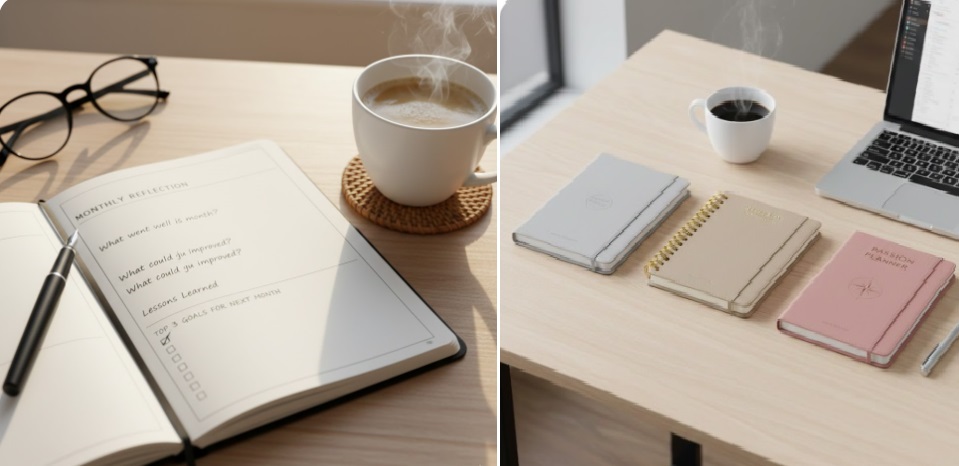
I do my daily planning while my coffee brews. It takes less than 10 minutes. Because I’ve anchored it to something I do every single day without thinking, my planning habit runs on autopilot.
Try this:
- Morning routine person? Plan before you check your phone
- Night owl? Use your evening routine as a review and planning window
- Lunch break planner? Set a 10-minute timer and use a simple daily planner layout
The magic is consistency through association, not willpower.
2. Use a Guided Planner, Not a Blank One
Blank planners look beautiful in flat lays. They are brutal for consistency.
Why? Because every single day you have to decide what to write, how to structure it, and what matters. That’s decision fatigue before you’ve even started planning.
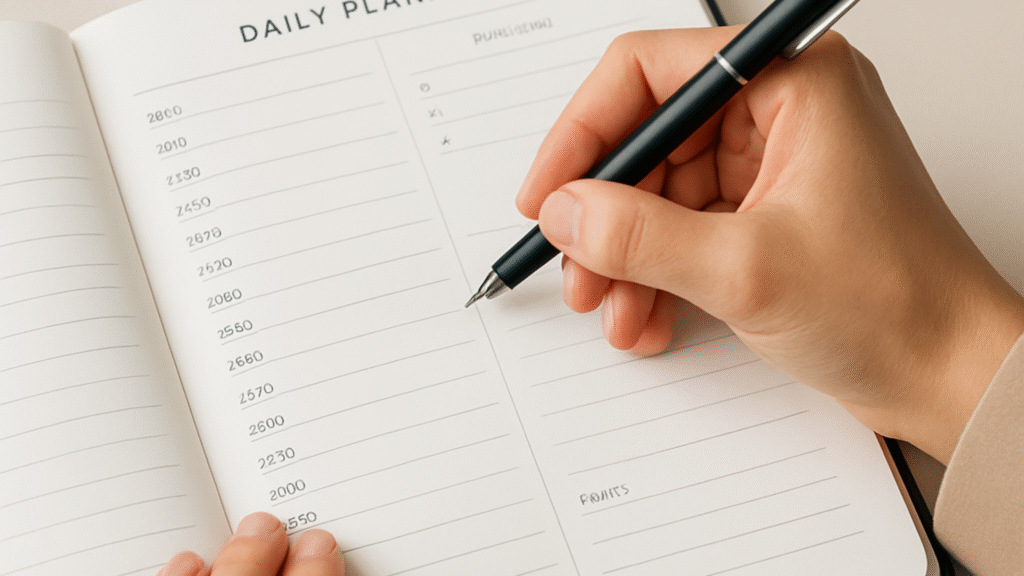
A guided planner removes that friction. The prompts are already there. The structure is already there. All you have to do is show up and fill it in.
This is why I built my guided planners the way I did. Every page is pre-structured with reflection prompts, task prioritization sections, habit trackers, and goal tracking tools, so your brain can focus on the thinking, not the formatting.
If you want to see what actually works vs what’s just hype, check out my honest breakdown of the best digital calendars in 2026.
3. Cut Your Planning Session Down to a Non-Negotiable Minimum
Here’s the version I tell every new planner: have a minimum viable planning session.
Not your full 30-minute weekly review. Not your elaborate monthly reset. Your floor, your bare minimum, the thing you do even on the worst day.
Mine is three things:
- Write down the one most important task for today
- Check my schedule for anything time-sensitive
- Do a 30-second brain dump if my head feels full
That’s it. Three minutes. Done.
On good days, I do more. On hard days, I do the minimum. But I never skip the minimum. That’s what keeps the habit alive.
The key to SMART goal-setting with your daily planner is building in a floor, not just a ceiling.
4. Make Your Planning Space Work For You
Your environment is either working for you or against you. There is no neutral.
If your planner is buried in a folder on your tablet, you won’t open it. If your journal is at the bottom of your bag, you won’t reach for it.
Set up your planning space intentionally:
- Pin your digital planner to your home screen or dock
- Put your printable planner on your desk, not in a drawer
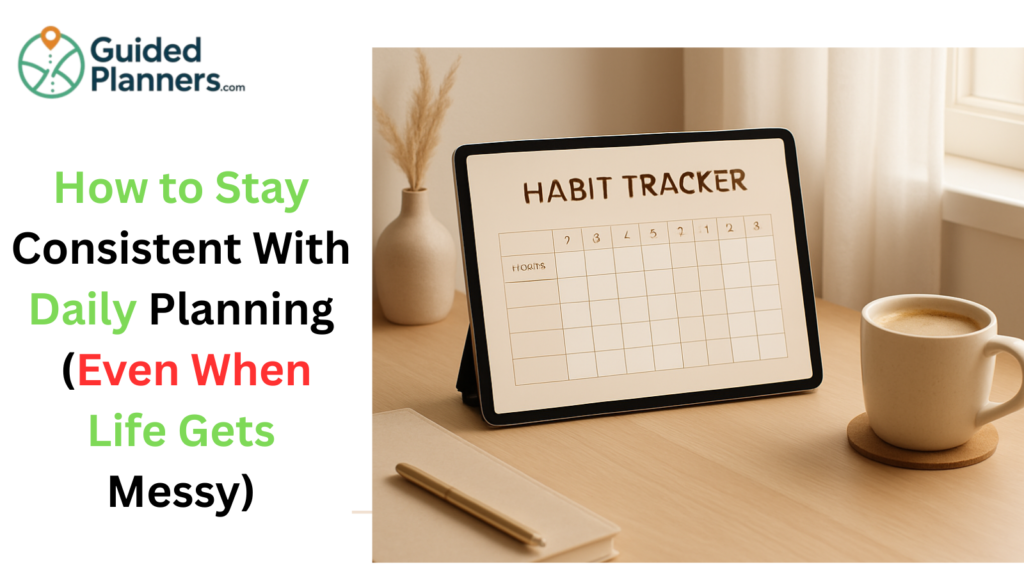
- Keep your habit tracker visible, not tucked away
- Use a dedicated app or PDF that loads fast with no friction
I’ve tested dozens of digital planning setups, and the ones people actually stick to are always the ones that are one tap or one reach away. Check out my honest picks for digital planners that actually work for real life if you want to see what I recommend and why.
5. Schedule a Weekly Planning Session (And Protect It)
Daily planning is the engine. Weekly planning is the fuel.
Once a week, usually Sunday evening, I sit down for 20 to 30 minutes with my weekly planner and do a proper review. I look at:
- What got done last week
- What didn’t, and why
- What’s coming up this week
- How my habits and goals are tracking
This weekly reset is what keeps your daily planning from feeling like you’re running blind. Without it, daily planning becomes just a to-do list. With it, your daily planning becomes part of a bigger goal tracking system.
Weekly planning is where your organization system actually comes to life.
6. Track Your Habit, Not Just Your Tasks
One of the sneakiest ways to boost planning consistency is to track the planning habit itself.
Add a simple checkbox or dot to your habit tracker that says: “Did I plan today?”
There’s something powerful about seeing that streak build. It creates its own motivation. It makes skipping feel like breaking something, not just missing something.
All of my guided planners include built-in habit trackers for exactly this reason. When you can see your consistency at a glance, it becomes something you protect.
Self-discipline isn’t about white-knuckling through hard days. It’s about building a system that makes showing up the path of least resistance.
7. Use Your Planner for Reflection, Not Just Scheduling
Most people use their planner like a calendar. Tasks in, tasks out.
That works for time management, but it doesn’t build the kind of intentional living that makes planning feel worth doing long-term.
The planners that stick are the ones that include reflection prompts.
- What worked today?
- What drained my energy?
- What am I proud of?
- What needs my attention tomorrow?
Structured journaling is a major part of how I design all my guided planners. When your planner helps you understand yourself, not just schedule yourself, you actually want to open it.
If you want a full comparison of what’s worth using right now, here’s my tested and ranked list of the best digital planners for 2026.
The Planning Consistency Formula (Simple Version)
If I had to boil everything above into one framework, here it is:
Right tool + Right trigger + Right minimum = Lasting consistency
- Right tool = A guided planner with built-in structure (not blank pages)
- Right trigger = Anchored to an existing daily habit
- Right minimum = A non-negotiable floor you can hit even on the worst days
That’s the whole system. Everything else builds from there.
What to Do When You Fall Off
You will fall off. Everyone does. Here’s how to handle it.
Do not try to catch up. Catching up is a trap. It creates a mountain of catch-up planning that feels so overwhelming you avoid it entirely.
Instead, do this:
- Open your planner to today, not last week
- Do your minimum viable planning session right now
- Write one reflection prompt: “What got in the way, and what’s one small shift I can make?”
- Move forward
That’s it. No guilt. No big reset ritual. Just re-entry.
The goal is to minimize your recovery time, not to avoid ever falling off.
Which Planner Is Actually Right for You?
I’ve spent five years designing planners for students, nurses, entrepreneurs, and everyone in between. The right planner depends on your life, not on what looks good in someone’s Instagram flat lay.
Here’s a quick breakdown:
| You are… | You probably need… |
|---|---|
| A visual person | A goal-setting planner with monthly spreads and vision board pages |
| Overwhelmed and scattered | A guided planner with brain dump pages and daily structure |
| A busy professional | A focus planner with time blocks and project planning sections |
| Building new habits | A habit tracker-focused wellness planner |
| A student | A daily and weekly planner with study scheduling |
Whatever your situation, start with structure. A guided planner gives you the framework so you’re not building from scratch every single morning.
You can browse all my current top picks in my complete 2026 digital planner buying guide.
FAQs: How to Stay Consistent With Daily Planning
How long should daily planning actually take?
Five to fifteen minutes is enough for most people. You don’t need an hour-long ritual. You need a short, repeatable session you’ll actually do every day.
What if I miss a day? Should I go back and fill it in?
No. Start fresh from today. Going back creates guilt and extra work. Your planner is a tool for moving forward, not a record of your failures.
Is digital or paper planning better for consistency?
Whichever one removes more friction for your specific life. Digital planners are great because they’re always with you on your phone or tablet. Paper planners work well if you love the tactile experience and have a set daily workspace.
How do I stop over-planning and under-executing?
Limit yourself to three priority tasks per day. If you get those three done, everything else is a bonus. Over-planning usually comes from trying to fit a week’s worth of tasks into one day.
Do I need a daily planner AND a weekly planner?
I recommend using both together. Your weekly planner gives you the big picture. Your daily planner gives you the action steps. They work as a system, not replacements for each other.
How do I build a morning routine around my planner?
Start with five minutes. Wake up, make your drink of choice, open your planner, and write down your top three priorities for the day before you look at your phone. That single habit changed everything for me.
The Bottom Line on How to Stay Consistent With Daily Planning
How to stay consistent with daily planning comes down to one core truth: the best planner is the one you actually open.
Not the prettiest. Not the most complex. Not the one with the most features.
The one you open, use, and return to, even when life gets messy.
Build your minimum. Anchor it to something real. Use a guided planner that does the heavy lifting for you. And give yourself permission to be human about it.
If you’re ready to find a planner that actually fits your life, start here: browse the best digital planners at Guided Planners and find the one that was built for the way you actually live.
Written by the team at Guided Planners — planner design experts with 5+ years of experience creating digital planners, printable planners, habit trackers, and productivity systems for real people with real lives.