If you’re staring at a blank notebook wondering where on earth to start your wedding planning, I see you.
I’ve spent over five years designing digital planners, and the number one thing I hear from couples is this: “I didn’t know there was so much to figure out.”
There is. But it doesn’t have to feel like chaos.
This wedding planner guide is going to walk you through everything — from locking in your wedding venue to managing RSVPs — without drowning you in overwhelm.
Let’s get into it.
- Why Most Couples Struggle With Wedding Planning (And What Actually Fixes It)
- Step 1: Lock In Your Wedding Vision First
- Step 2: Build Your Wedding Timeline (Start Earlier Than You Think)
- Step 3: Create a Real Wedding Budget (Not an Optimistic One)
- Step 4: Choose Your Vendors Like You're Hiring Employees
- Step 5: Nail Your Wedding Ceremony and Reception Flow
- Step 6: Manage Your Bridal Party Without the Drama
- Wedding Planning Mistakes I See Over and Over
- Wedding Trends in 2026 Worth Knowing About
- The Tools That Make Wedding Planning Easier
- FAQs: Wedding Planning Questions I Get Asked All the Time
- You've Got This — But You Don't Have to Do It Alone
- Start free. No risk.
Why Most Couples Struggle With Wedding Planning (And What Actually Fixes It)
Here’s the truth nobody tells you upfront.
Wedding planning isn’t hard because the tasks are complicated.
It’s hard because there are hundreds of moving parts happening at the same time, across months, with money on the line and family opinions flying in from every direction.
The couples who pull off beautiful weddings without losing their sanity all share one thing in common.
They had a system.
Not a mood board. Not a Pinterest folder.
A real, organized system — a wedding checklist, a wedding timeline, and a clear budget breakdown — so nothing slipped through the cracks.
That’s what I want to help you build today.
Step 1: Lock In Your Wedding Vision First
Before you book anything, answer these three questions:
- How many guests are you inviting? (This controls everything.)
- What’s the vibe? Rustic wedding, luxury wedding planning, destination wedding packages, beach wedding, garden wedding — pick a lane.
- What’s the number you’re comfortable spending? Not “what do we think we can stretch to” — what’s the real number?
Your wedding theme, your wedding venue, your caterer, your florist — all of it cascades from these three answers.
I’ve seen couples fall in love with a luxury wedding venue before setting a guest count, then realize they can only invite 40 people to make it work.
That’s a painful backtrack.
Set the foundation first.
Step 2: Build Your Wedding Timeline (Start Earlier Than You Think)
Here’s a wedding timeline template that works for most couples planning a 12-month engagement:
12 Months Out
- Set your wedding budget
- Choose your wedding date
- Book your wedding venue
- Start your bridal party conversations
9–10 Months Out
- Book your wedding photographer and wedding videographer
- Book your caterer
- Start wedding dress shopping (yes, this early — bridal gowns take time)
- Send save the date cards
6–8 Months Out
- Book your florist, wedding decorator, DJ or live band
- Book your hair stylist and makeup artist
- Book your wedding officiant
- Design and send wedding invitations
4–5 Months Out
- Finalize your wedding color palette and floral arrangements
- Confirm all vendor contracts
- Start RSVP management
2–3 Months Out
- Finalize your wedding day schedule
- Confirm table settings, wedding lighting, and wedding décor
- Final dress fitting
1 Month Out
- Final headcount to caterer
- Confirm your wedding timeline with every vendor
- Prepare payments and tips
Week Of
- Hand off your planning binder to a point person
- Rest. Seriously.
If you’re working with a shorter engagement, compress the timeline — but keep the order the same. The sequence matters.
Step 3: Create a Real Wedding Budget (Not an Optimistic One)
I’ll be straight with you.
Most couples underestimate their wedding budget by 20–30%.
Why? Because they price out the big stuff — venue, caterer, wedding photographer — and forget about the fifty other line items that add up fast.
Here’s what gets people:
- Wedding invitations and postage (more than you think)
- Tips for vendors (standard is 15–20%)
- Alterations for bridesmaid dresses and bridal gown
- Wedding lighting upgrades at the venue
- Day-of coordination if your venue doesn’t include it
- Rehearsal dinner
- Welcome bags for out-of-town wedding guests
- Favors
- Marriage license fee
Build your budget with a buffer of at least 10–15% for surprises.
And if you want a tool that does the heavy lifting for you, our Wedding Budget Planner Book and Payment Tracker lays out every category so nothing gets missed.
I also wrote a full breakdown on how to save money on your wedding — real strategies, not generic advice.
Step 4: Choose Your Vendors Like You’re Hiring Employees
Because you are.
Your wedding photographer, videographer, caterer, florist, DJ or live band — these people are delivering your wedding day experience.
Here’s how I recommend approaching vendor contracts and booking:
Do your research before you reach out. Look at their full portfolio, not just their highlight reel. Read reviews on third-party sites, not just testimonials on their website.
Ask the right questions.
- Are you available on my date?
- How many weddings do you do per weekend?
- What happens if you get sick or have an emergency?
- What does your contract include?
Get everything in writing. Every detail. Every deliverable. Every timeline.
Don’t book based on price alone. A cheaper wedding photographer who doesn’t capture your moments the way you wanted will haunt you longer than a tight budget month.
Step 5: Nail Your Wedding Ceremony and Reception Flow
The wedding day schedule is where a lot of couples drop the ball — not because they don’t care, but because they underestimate how much time everything takes.
Here’s a sample wedding day schedule for a 5pm ceremony:
| Time | Event |
|---|---|
| 10:00 AM | Hair and makeup begins for bridal party |
| 1:00 PM | Wedding photographer arrives for getting-ready shots |
| 2:30 PM | First look (optional) |
| 3:30 PM | Wedding party and family photos |
| 4:30 PM | Guests begin arriving |
| 5:00 PM | Wedding ceremony begins |
| 5:30 PM | Cocktail hour begins |
| 6:30 PM | Wedding reception doors open |
| 7:00 PM | Grand entrance, first dance |
| 7:15 PM | Dinner service begins |
| 8:00 PM | Toasts and speeches |
| 8:30 PM | Open dance floor |
| 9:30 PM | Cake cutting |
| 11:00 PM | Last dance and send-off |
Add 15-minute buffers between major transitions.
Everything runs longer than you plan.
Step 6: Manage Your Bridal Party Without the Drama
Your bridal party is your inner circle.
They’re also human beings with schedules, budgets, and opinions.
Set expectations early and clearly:
- Bridesmaid dresses: Give them a color or color palette and a budget range. Let them choose within it when possible.
- Wedding day schedule: Share it with them at least 2 months out.
- Responsibilities: Be specific. “Be there for me” is not a job description.
If you want the full breakdown on bridal party management, especially from the mother of the bride perspective, I put together a dedicated resource on the best wedding planner for mother of the bride.
Wedding Planning Mistakes I See Over and Over
I’ve reviewed hundreds of planning approaches over the years.
These are the mistakes that show up constantly:
Waiting too long to book vendors. The best wedding photographers and popular venues book out 12–18 months in advance. If you’re working with a shorter timeline, move fast.
Not having a single place for everything. Scattered notes across your phone, email, random notebooks — this is how things fall through the cracks. A dedicated wedding planner book keeps everything in one place.
Letting too many people have opinions. Gather input early. Set a decision deadline. Move forward.
Ignoring the guest experience. Your wedding guests are traveling, taking time off, buying gifts. Think about parking, accessibility, clear ceremony programs, and a smooth cocktail hour.
Skipping a rehearsal dinner run-through. This is where you iron out the logistics so the actual day flows.
Wedding Trends in 2026 Worth Knowing About
The wedding industry keeps moving.
Here’s what’s showing up in 2026 planning conversations:
- Eco-friendly weddings: Couples are choosing locally sourced florals, digital wedding invitations, and sustainable catering options.
- Minimalist weddings: Less décor, more intentionality. Quality over quantity in every category.
- Cultural wedding traditions woven into modern ceremonies — honoring heritage without a fully traditional format.
- Destination wedding packages that include more services bundled, making the planning simpler for guests and couples.
- Micro-weddings and intimate ceremonies continue to be popular — smaller guest lists, higher per-person investment.
- Interactive reception experiences: Photo booths, live stations, custom cocktail bars.
You don’t have to follow trends. But knowing them helps you decide what actually fits your vision versus what’s just noise.
The Tools That Make Wedding Planning Easier
I built Guided Planners because I watched too many people struggle with disconnected tools.
Here’s what I recommend:
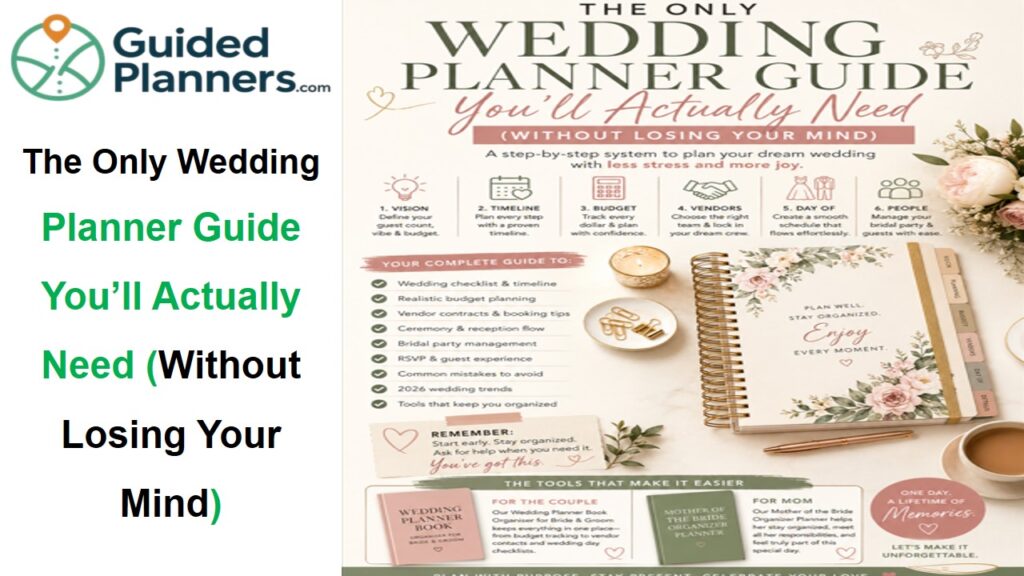
For the couple planning together: Our Wedding Planner Book Organiser for Bride and Groom is designed so both partners can stay aligned. It covers everything from vendor contacts to wedding day checklists, budget tracking to planning milestones.
For the mother of the bride: She deserves her own system too. Our Mother of the Bride Organizer Planner helps her stay on top of her responsibilities, coordinate her own outfit timeline, and feel genuinely part of the process — not just a bystander.
These aren’t generic planners with blank pages. They’re structured, designed specifically for weddings, and built to make task management feel manageable instead of overwhelming.
FAQs: Wedding Planning Questions I Get Asked All the Time
For a traditional wedding with 100+ guests, start 12–18 months out. For a smaller wedding or micro-wedding, 6–9 months is workable if you move quickly on vendors.
Your wedding venue. Everything else — caterer, photographer, DJ — depends on the venue’s date availability and logistics.
Start with your wedding date and work backwards. Assign tasks to months and assign each task to a person. A printed or digital wedding planner binder keeps this organized far better than a mental list.
It varies widely by location and guest count. In the US, the average wedding runs between $25,000–$35,000. But I’ve seen gorgeous weddings done for $10,000 and stress-filled ones at $80,000. Your number depends on what you’re prioritizing.
Yes. A venue coordinator manages the venue. A wedding coordinator manages your entire day. They’re different roles.
A wedding planner helps you plan everything leading up to the wedding — vendor selection, budget, logistics. A day-of coordinator executes the plan on the wedding day. Some people do both; make sure you know which you’re hiring.
Set a firm RSVP deadline (3–4 weeks before the wedding). Follow up personally with non-responders one week after the deadline. Give your final headcount to the caterer 2 weeks out.
You’ve Got This — But You Don’t Have to Do It Alone
Wedding planning is one of the most complex logistical projects most people will ever take on.
It’s also one of the most meaningful.
The couples who enjoy the process are the ones who give themselves a real system to work from.
A solid wedding checklist. A realistic wedding timeline. A wedding budget they actually understand. A planner that keeps it all together.
That’s what wedding planning looks like when it works.
Whether you’re planning a destination wedding, a garden wedding, an eco-friendly wedding, or a luxury wedding — the foundation is the same.
Start early. Stay organized. Ask for help when you need it.
And if you’re the mother of the bride trying to hold it all together with grace, I built something just for you too: the Mother of the Bride Organizer Planner.
This is your wedding planner guide — save it, share it, come back to it.
You’ve got this.